The breed standard is the written blueprint of the ideal English Bulldog — a description against which all specimens of the breed are evaluated in conformation competition and by responsible breeders assessing their breeding stock. Understanding the standard helps owners appreciate what makes a Bulldog a Bulldog and what breeders strive to produce.
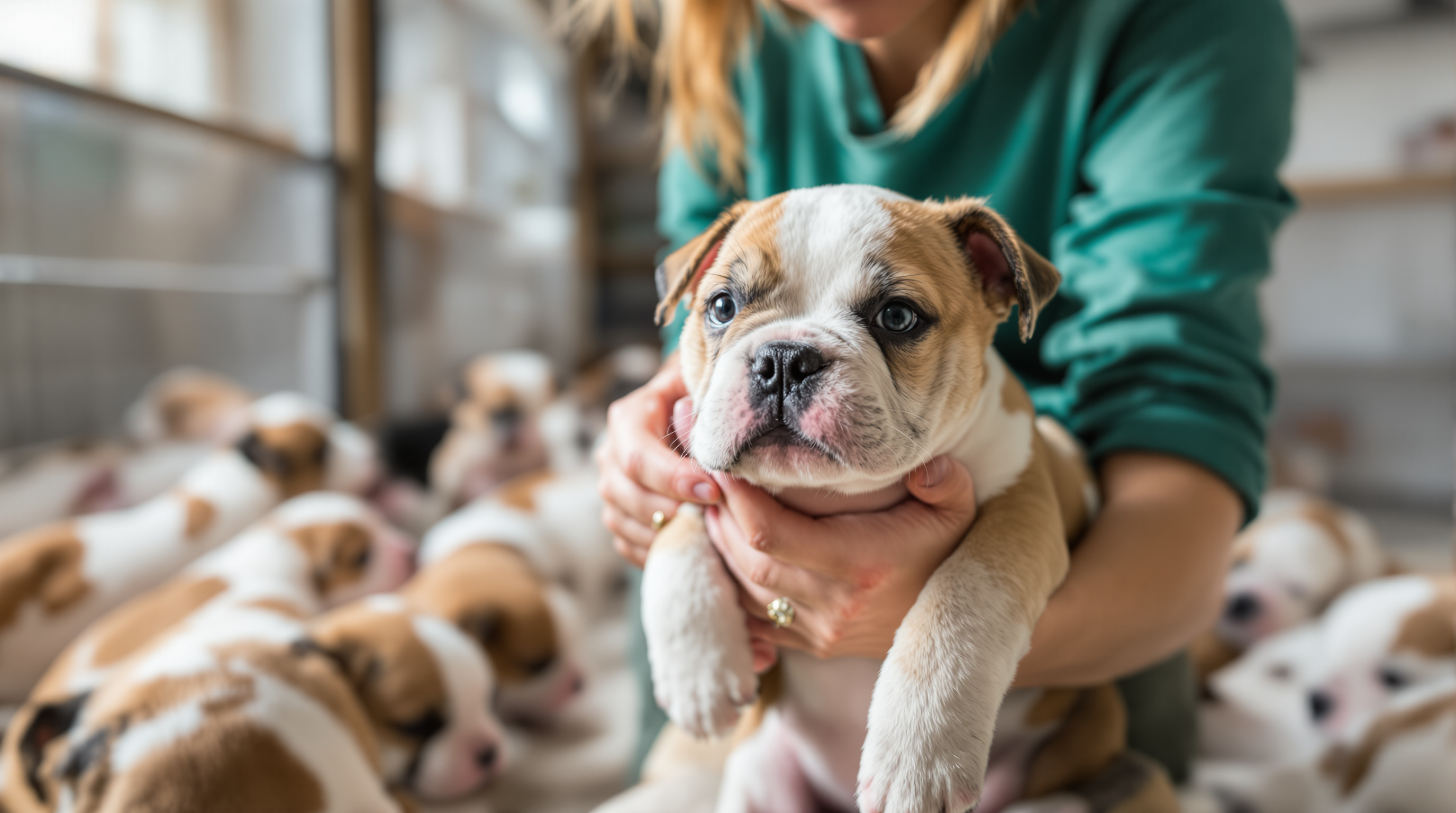
The official breed standard for the English Bulldog, as maintained by the American Kennel Club and the Bulldog Club of America, describes the characteristics that define the breed in precise terms. The following is an overview of the key points.
General Appearance
The perfect Bulldog must be of medium size and smooth coat; with heavy, thick-set, low-swung body, massive short-faced head, wide shoulders, and sturdy limbs. The general appearance and attitude should suggest great stability, vigor, and strength. The disposition should be equable and kind, resolute and courageous — but not vicious or aggressive.
The expression should convey the impression of determination, strength, and activity. The body should be large, heavy, and compact. The head should be large and of extreme size. The dog should be active, giving an impression of strength and energy.
Size, Proportion, and Substance
The Bulldog is a medium-sized breed with a compact, low-slung, muscular body. Mature dogs should weigh approximately 50 pounds; mature bitches approximately 40 pounds. The dog is somewhat lower in the rear than in the shoulder and higher in the front, with a short, strong back rising to the loins — this characteristic "roach back" is distinctive to the breed.
The Head
The head is one of the Bulldog's most characteristic features and is described in extensive detail in the standard. Key points include:
- Skull: Very large, with great breadth. The forehead should be flat — neither too prominent nor overhanging the face. The circumference of the skull in front of the ears should measure at least the height of the dog at the shoulders.
- Face: The face, measured from the front of the cheekbone to the tip of the nose, should be as short as possible. The skin of the forehead and head should fall loosely in heavy wrinkles.
- Muzzle: Very short, broad, turned upward, and deep from the corner of the eye to the corner of the mouth. The nostrils should be large, wide, and open. Wry jaws are a serious fault.
- Jaw: Broad, massive, square. The lower jaw should project considerably in front of the upper jaw and turn up. There should be a limited amount of looseness of skin under the throat forming dewlap.
- Teeth: Six small front teeth (incisors) between the canines should be in an even, level row.
- Eyes: Medium size, round in shape, of a very dark color. They should be quite in front of the head, as far from the ears as possible. The lids should cover the white of the eyeball when the dog is looking directly forward.
- Ears: The ears should be set high in the head, the front inner edge of each ear joining the outline of the skull at the top back corner. The ear should be small and thin, folded so as to bring a portion of the burr forward and downward. This is the "rose ear" — a distinctive Bulldog characteristic. Button or upright ears are serious faults.
Neck, Topline, and Body
Neck: The neck should be short, very thick, deep, and strong. It is well-arched at the back. The skin is loose and wrinkled at the throat.
Topline: The Bulldog has a characteristic "wheel back" — the back dips just behind the withers, rises to the loins, and then curves again toward the tail. This is a defining characteristic of breed type.
Body: The chest is very broad, deep, and full. The chest should be very prominent, giving the dog a wide-chested appearance and presenting the impression of power. The brisket and body are very capacious. The belly is tucked up.
Tail: The tail may be straight or "screwed" (but not curly). A straight tail is preferred. The tail is set low, with decided downward carriage.
Forequarters and Hindquarters
Shoulders: The shoulders are muscular, heavy, widespread, and slanting outward, giving the impression of great stability and power. The forelegs are short and very stout, as well as straight and muscular. The distance from the back of the foreleg to the elbow joint should be as short as possible.
Feet: The feet should be moderate in size, compact, and firmly set. The toes should be compact and thick — well split up, making the knuckles prominent and high. The feet should turn outward slightly. Rear feet are not as large as front feet.
Hindquarters: The hind legs are strong and muscular and longer than the forelegs, so as to elevate the loins above the withers. The hocks are slightly bent and well let down.
Coat and Color
Coat: The coat should be straight, short, flat, close, of fine texture, smooth and glossy. No fringe, feather, or curl.
Color: The following colors are acceptable per the breed standard, in order of preference:
- Red brindle (most prized)
- All other brindles
- Solid white
- Solid red, fawn, or fallow
- Piebald
- Inferior: inferior qualities of all the foregoing
Disqualifying colors: Black and tan, liver (chocolate), and black (without any trace of brindle) are considered disqualifying colors by the standard. Dilute colors and patterns not described in the standard are not recognized by the AKC.
Gait
The Bulldog has a unique gait — sometimes described as a "loose-jointed, shuffling, sidewise motion." The characteristic rolling, waddling walk is unmistakably Bulldog. When trotting, the movement should be unrestrained, free, and vigorous. The paws should not rise high or far from the ground.
Temperament
The Bulldog's temperament is described in the standard as "equable and kind, resolute and courageous." A Bulldog that is vicious or aggressive is at odds with the standard and should never be bred. The Bulldog's characteristic expression of determination and courage — without aggression — is central to what the breed is meant to be.
Understanding the Standard as an Owner
You don't need to be a breeder or exhibitor to benefit from understanding the breed standard. It explains why Bulldogs look and move as they do, and it helps owners understand health implications. A dog that deviates significantly from standard proportions — particularly in head structure and airway anatomy — may face more significant health challenges. Responsible breeders use the standard as a guide to producing healthier as well as more typey dogs.